Your furnace is getting older and the heat seems slower, so swapping the box and keeping the ducts sounds like an easy win. Sometimes it is. More often, the smart answer depends on two things you can't see from those stairs: how much air your ducts actually lose, and what your electric rate does to every winter bill. Get both right and you protect your family's comfort and your budget for years.
TL;DR Quick Answers
what is an electric furnace
An electric furnace is a central heating system that warms air by passing it over electric heating elements, then uses a blower to push that heat through your home’s ducts. It burns no fuel, so there’s no flame or carbon monoxide, and it turns nearly all the electricity it draws into heat.
How it heats: Most units hold three to seven elements of about five kilowatts each. They switch on in stages so your electrical panel never takes the full load at once.
What it depends on: Your filter and your ducts. Every bit of air passes the filter first, and a clogged one can trip the limit switch and shut your heat off.
What it costs to run: That comes down to your electric rate. In most climates, a heat pump can heat the same home on about half the electricity.
Where it fits best: Homes with mild winters, a tight upfront budget, or a heat pump that needs backup heat.
Top Takeaways
Ducts outlast furnaces: sound ductwork can serve several heating systems over its life.
Test before you trust them: a typical duct system loses 20 to 30 percent of its air to leaks.
Your climate decides: electric furnaces fit mild winters, and heat pumps usually win in cold ones.
Run the numbers: kilowatts times hours times your rate shows what a system costs to run.
The 25C credit is over: look to state and utility programs for 2026 savings.
What Is an Electric Furnace and How Does It Use Your Ducts?
It helps to know the answer to what is an electric furnace before you decide whether to replace one. It heats air with electric elements rather than burning fuel. The U.S. Department of Energy says each element typically runs at about five kilowatts, and most units hold three to seven of them. They switch on in stages, so your electrical panel never takes the whole load at once.
A blower pulls room air in through your return ducts and filter, pushes it across the hot elements, and sends it back out through the supply ducts. Every bit of that air hits the filter first. That filter guards both the air your family breathes and the elements themselves. The furnace makes the heat, and your ducts decide how much of it shows up where you live.
Why Good Ductwork Changes the Replacement Math
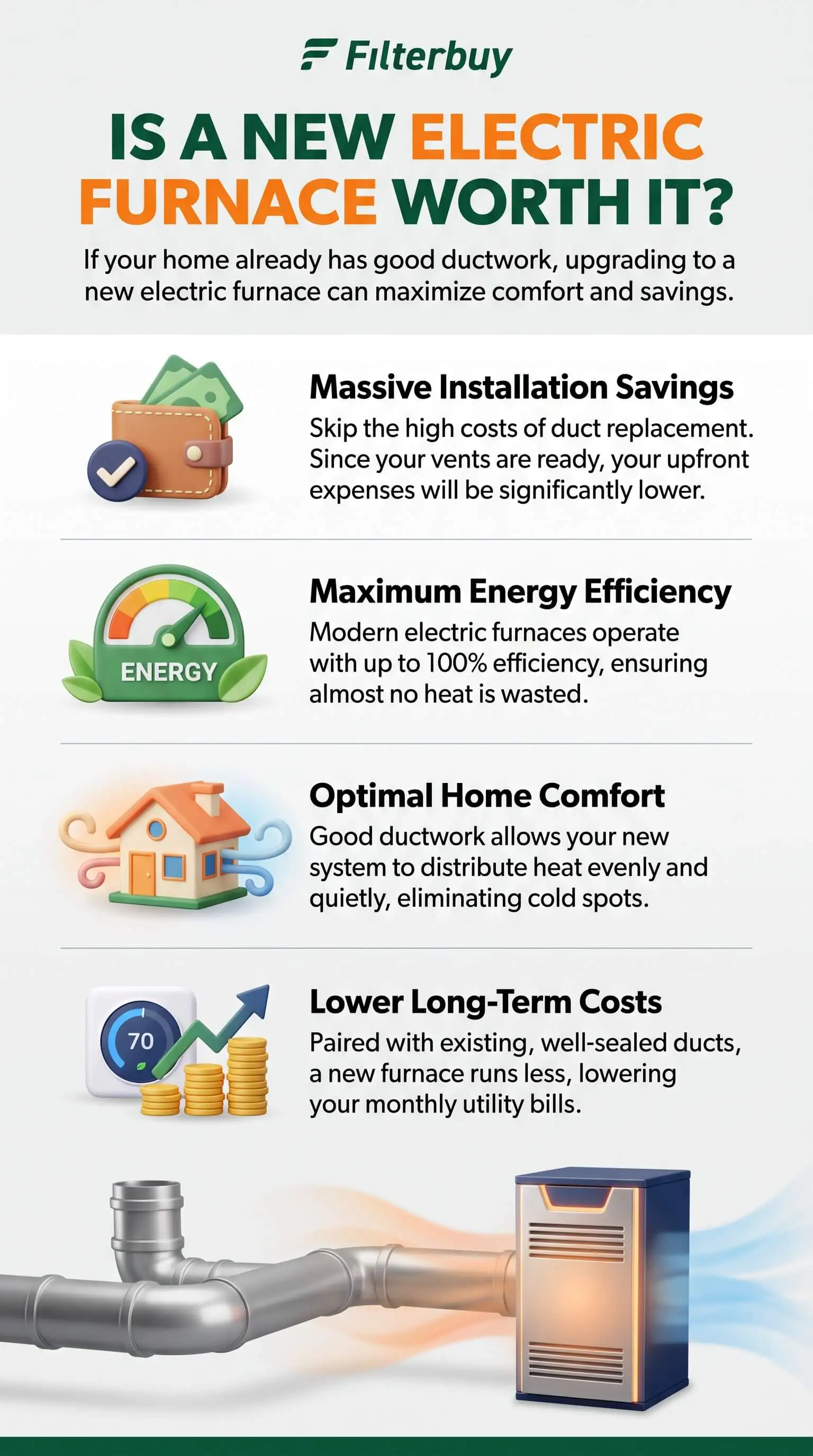
Your ducts will probably outlast every furnace you ever connect to them. InterNACHI, the home inspectors' association, puts ducting life at 60 to 100 years and a furnace at 15 to 25. Sound ducts mean you get to choose which heating system deserves them.
They also keep your options open. In a forced-air furnace system, the same blower and duct layout can serve an electric furnace, a heat pump, or both together. You already own that flexibility.
The trouble is that ducts can look fine and still leak badly. ENERGY STAR estimates that a typical home loses 20 to 30 percent of the air moving through its ducts to leaks, holes, and poor connections. Put a brand-new furnace on leaky ducts and you've bought a brand-new furnace for your attic.
How to Confirm Your Ducts Are Really in Good Shape
Before you sign anything, ask your contractor to check these:
Duct leakage test: it measures how much air escapes the system.
Static pressure reading: it shows whether the ducts can carry the airflow a new system needs.
Sealed joints: look for mastic or metal foil tape, not cloth duct tape.
Insulated runs: wrap any ducts in the attic, crawlspace, or garage.
Even temperatures: no room should always run cold.
A tight filter slot: gaps let dust slip right past the filter and into the air you breathe.
Pass those checks, including making sure your pleated furnace filter is in good condition, and you can price new equipment with confidence.
When a New Electric Furnace Is Worth Buying
An electric furnace makes good sense in a handful of situations:
Mild winters: the Department of Energy notes that electric resistance heat can make sense where heating days are so few that the cost stays small.
A tighter upfront budget: with no outdoor unit, refrigerant lines, or flue, installation is simpler.
A shorter stay: if you plan to move within a few years, a pricier system's longer payback may never reach you.
A heat pump partner: many new electric furnaces end up as the air handler and backup heat for a heat pump.
No combustion: an electric furnace produces no carbon monoxide, which some families value.
At the point of use, it turns nearly all the electricity it draws into heat. What matters is what that electricity costs you.
When a Heat Pump Is the Better Use of Good Ducts
A heat pump moves heat instead of making it. When electricity is your only option, the Department of Energy says heat pumps are preferable in most climates, and they can cut the electricity you use for heating by about half compared with electric resistance heat.
Good ducts make that switch easier. DOE points out that homes with existing ductwork can usually move from a furnace to a heat pump or a hybrid setup more easily than homes without it. According to DOE, cold-climate heat pumps keep working at temperatures as low as 5°F. On the rare nights it drops lower, the electric heat strips in your air handler step in as auxiliary or emergency heat.
A heat pump costs more upfront, adds an outdoor unit, and needs correct sizing. A Manual J load calculation, the industry standard for sizing home equipment, keeps you from paying for more or less capacity than you need. High efficiency filters also deserve consideration when evaluating airflow requirements and overall system performance.
What It Costs to Run and Install in 2026
You can work out running costs with your own bill: kilowatt rating times hours of runtime times your electric rate.
Say a 15 kW furnace runs five hours on a cold day. That's 75 kWh. At 17 cents per kWh, you'd pay about $12.75 for the day. A heat pump that cuts heating electricity in half brings that same day closer to $6.40, and the gap widens as winters get colder and rates climb.
Installed prices swing widely by region, home size, and electrical work. Get at least two written quotes that list equipment, labor, and any panel or breaker upgrades on separate lines.
Tax Credits and Rebates After the 25C Credit Ended
The federal Energy Efficient Home Improvement Credit, or 25C, covered qualifying heat pumps. The IRS limits it to property placed in service through December 31, 2025, and electric resistance furnaces never made its qualifying list. For a 2026 install, check with your state energy office and your electric utility, because some still offer heat pump rebates.
Repair, Replace, or Upgrade: A Quick Decision Checklist
Under 15 years old with one failed part: a burned-out element or sequencer is often a repair, not a reason to replace the whole furnace.
15 to 25 years old with repeat breakdowns: start pricing replacements. These signs you need a new HVAC system can help you judge the timing.
Limit switch tripping often: check the filter and look for blocked returns first. A clogged filter can shut the furnace down by itself.
Bills climbing with no rate change: test the ducts before you blame the equipment.
Staying 10 or more years in a cold climate: ask for a heat pump quote alongside the furnace quote.
Still torn? The same logic behind repair or replace decisions on cooling equipment works here too. Weigh the repair cost against the system's age and what a new one would save you.
"In my experience, the electric furnaces that seem to fail early are usually sitting on ducts nobody ever tested. Before I quote a replacement, I take a static pressure reading. If the ducts are choking the blower, a new furnace will trip its high limit just like the old one did, and the homeowner ends up paying twice to learn that."
Essential Resources
What Is an Electric Furnace and How It Works: a plain-language guide to how an electric furnace works and how to care for its filter.
IRS: Energy Efficient Home Improvement Credit: the official dates and rules for the 25C credit.
InterNACHI: Estimated Life Expectancy Chart for Homes: how long furnaces, heat pumps, and ducting typically last.
EPA: Guide to Air Cleaners in the Home: how to pick a furnace filter and how often to change it.
ACCA: Manual J Residential Load Calculation: the contractor standard for sizing home heating and cooling.
NEEP: Cold Climate Air Source Heat Pump Product List: heat pumps tested for cold-weather performance.
NASEO: Residential Energy Efficiency Task Force: where state energy offices track their home rebate programs.
Supporting Statistics
A typical house loses about 20 to 30 percent of the air moving through its ducts to leaks, holes, and poor connections. ENERGY STAR
Heat pumps can cut electricity use by about 50 percent compared with electric resistance heating. U.S. Department of Energy
In 2024, 42 percent of U.S. households named electricity as their main space heating fuel. U.S. Energy Information Administration
With 20–30% of duct air potentially lost through leaks, heat pumps offering around 50% lower electricity use than electric resistance heating, and 42% of U.S. households relying on electricity for heating, efficient ductwork and proper equipment selection are essential to a well-functioning air conditioning system.
Final Thoughts
In my view, good ductwork is the best reason to slow down before you buy a new electric furnace, not a reason to hurry. If your winters are short and mild, a new electric furnace is a sensible, simple pick. Long winters change the math. There, I'd let a heat pump handle the daily work and keep electric heat as the backup. Whichever way you lean, test the ducts first, because that single step turns a guess into a decision you can stand behind.
Frequently Asked Questions
How long does an electric furnace last?
InterNACHI puts a furnace's life at 15 to 25 years. Parts like the heating elements or the sequencer can fail sooner and are often replaceable. Changing the filter on schedule protects them, because a clogged filter makes the elements run hot and trip the limit switch.
Can I install a heat pump on my existing ductwork?
Often, yes. The Department of Energy notes that homes with existing ducts can usually switch to a heat pump or hybrid system more easily than homes without them. Ask your contractor to confirm the ducts can carry the airflow the new system needs.
Is an electric furnace cheaper to run than a heat pump?
Usually not. A heat pump moves heat instead of creating it, so it can get by on about half the electricity that electric resistance heat uses.
Do I need to replace my ductwork when I replace my furnace?
Not if your ducts pass a leakage test and a static pressure check. Sealing joints with mastic and insulating exposed runs usually costs far less than new ductwork.
Is there still a federal tax credit for a new furnace or heat pump in 2026?
No. The IRS limits the 25C credit to property placed in service through December 31, 2025. For a 2026 install, check your state energy office and electric utility for current heat pump rebates.
Make the Most of the Ductwork You Already Have
Good ductwork gives you more options than a single replacement quote lets on. Test your ducts, compare an electric furnace with a heat pump on the same system, and pick the one that fits your climate and your plans. MERV 8 pleated furnace air filters trap common airborne particles while maintaining proper airflow through your heating system.


