The thermostat read 72 degrees and the sheets were still damp. That was the bedroom I walked into last August, 143 square feet with a 12,000 BTU head on the wall, and the owner couldn't work out what he'd done wrong. He'd asked himself what size mini split do I need, then answered it by buying the largest unit his budget allowed. Moisture is the part of this decision nobody can see, and it's the part that settles whether a room feels right at two in the morning. In a small bedroom the mistake runs backward from what most people expect. Everyone worries about buying too little capacity, and almost every bedroom I get called back to has too much. That's why asking what size mini split do I need before buying the unit is one of the most important steps in getting the sizing right.
TL;DR Quick Answers
what size mini split do i need
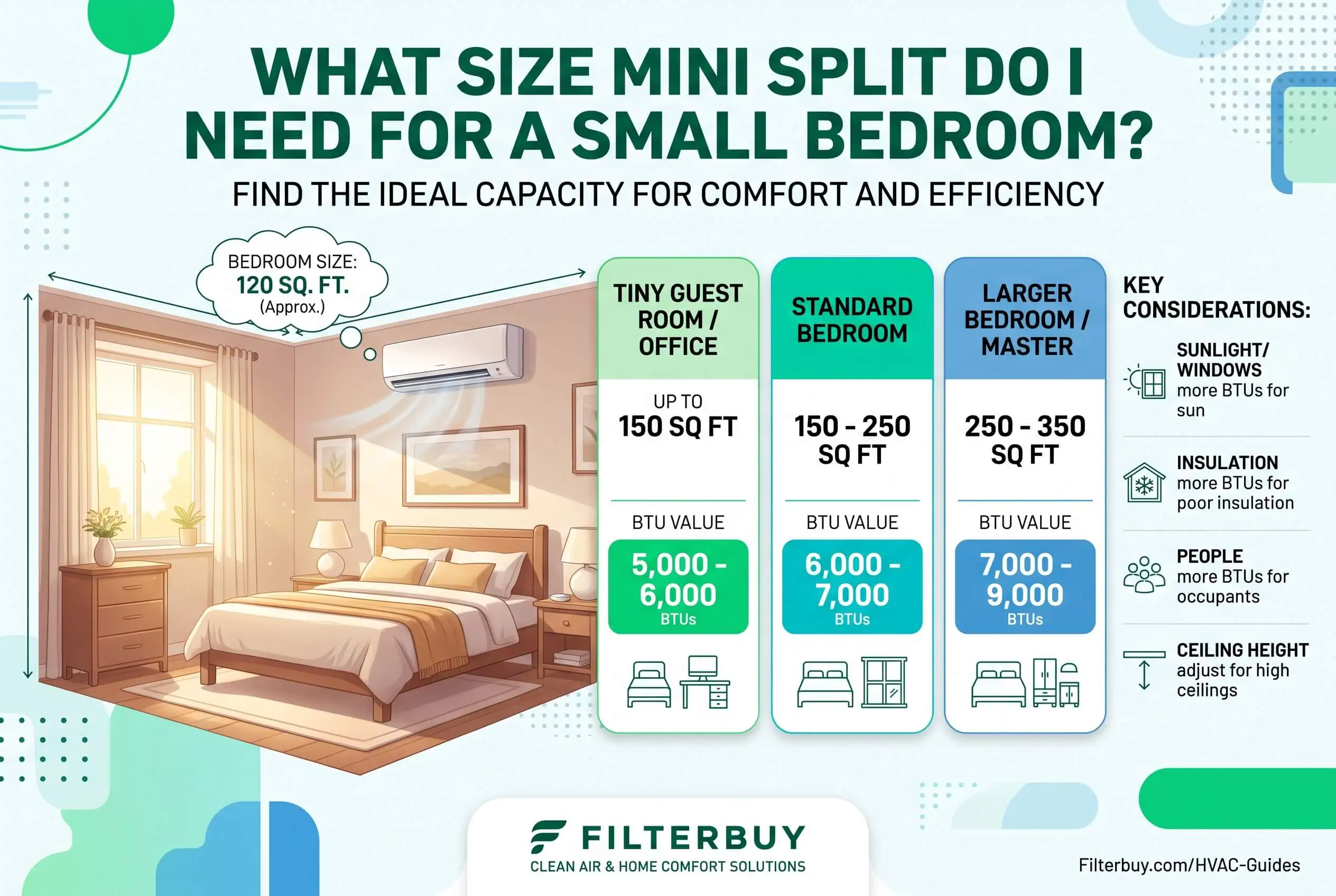
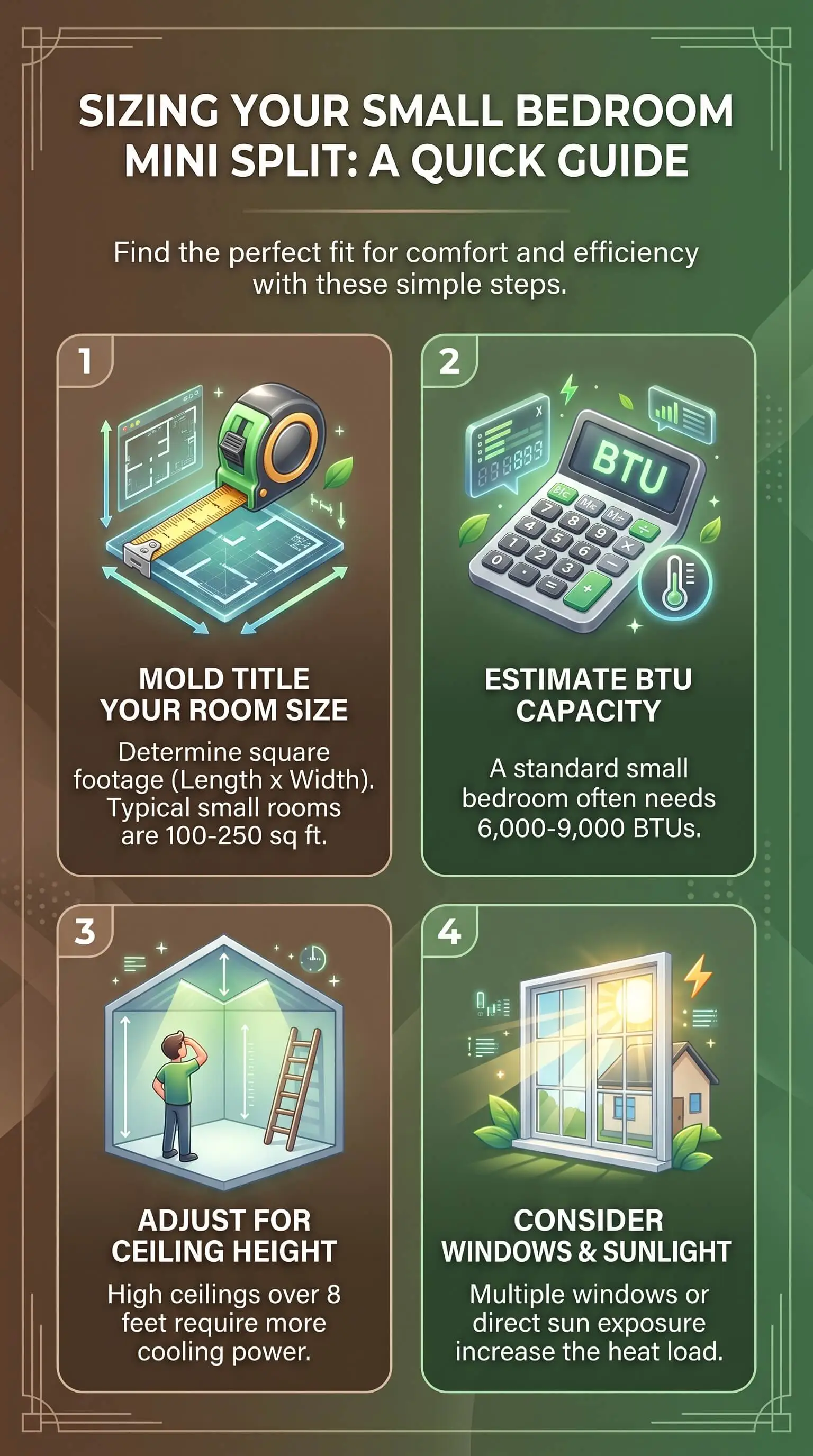
Multiply your room's square footage by 20 to 25 BTU to get a baseline, then match that number to the nearest head size. Most small bedrooms take 6,000 to 9,000 BTU. When your figure falls between two tiers, size down and let the inverter carry peak days.
Room size to head size:
100 to 250 sq ft: 6,000 BTU
250 to 350 sq ft: 9,000 BTU
350 to 550 sq ft: 12,000 BTU
550 to 800 sq ft: 18,000 BTU
800 to 1,200 sq ft: 24,000 BTU
Adjust that baseline for:
Ceilings above eight feet: add 10 percent per foot
West or south afternoon sun: add 10 percent
Weak insulation or a room over a garage: add 20 percent
Each person beyond two: add 600 BTU
What I'd tell you at the kitchen table: oversizing generates more complaints than undersizing ever has. A head that's too large reaches the setpoint before it pulls any moisture out, so the room lands cold and clammy at the same time. Measure the space, run the math, and buy the smaller of the two tiers you're stuck between.
Top Takeaways
Most small bedrooms need 6,000 to 9,000 BTU. Rooms from 100 to 250 square feet rarely justify more.
12,000 BTU is the most common mistake. It short cycles, skips the moisture removal, and leaves you cold and damp at the same time.
Five factors move your number. Ceiling height, sun exposure, insulation, climate humidity, and how many people sleep in the room.
Size down before you size up. An inverter compressor handles peak days better than an oversized head handles ordinary ones.
Check the install path first. No line set route means no mini split, whatever the capacity math says.
How Many BTUs a Small Bedroom Actually Needs
Start with the floor area. An 11 by 13 bedroom gives you 143 square feet, and multiplying by the standard 20 to 25 BTU per square foot lands you somewhere between 2,900 and 3,600 BTU.
Nobody builds a ductless head that small. The smallest single-zone indoor unit on the market puts out 6,000 BTU, and the tiers step up from there to 9,000 and 12,000. So the arithmetic hands you a floor rather than an answer.
Here's what has held up across every small bedroom I've sized. A room between 100 and 250 square feet with eight-foot ceilings, decent windows, and average insulation runs well on a 6,000 BTU head. Move up to 9,000 when the room fights back with heavy afternoon sun, thin insulation, or a genuinely hot and humid climate. That per-square-foot rule understates small rooms, because the walls, windows, and doors carry a bigger share of the heat load when there's less floor to spread it over.
Sizing the rest of the house while you're at it? This mini split sizing guide by room size lays out the full BTU ladder from small bedrooms up through open living areas, helping you choose the right capacity so air conditioners control humidity as effectively as they cool.
Why 12,000 BTU Is Usually Too Much for a Bedroom
An oversized head cools the air fast and then quits. That sounds efficient right up until you look at what the machine is doing while it runs.
A mini split pulls moisture out of a room only while the coil stays cold and air keeps moving across it. The vapor compression cycle behind all air conditioning condenses water on that coil, and condensation needs runtime. Cut the runtime and you cut the dehumidification along with it.
Drop a 12,000 BTU unit into 143 square feet and it reaches the setpoint in a few minutes, then shuts off. Thermostat says 72. The room feels like a basement. Installers call that short cycling, and it drives up the electric bill while it wears on the compressor. Avoiding these issues is one reason homeowners consider upgrading AC system performance through proper sizing rather than simply choosing a larger unit. Manufacturers rate moisture removal with a figure called sensible heat ratio, where a lower number means the unit pulls out more water. Plenty of high-efficiency ductless heads score poorly on it, which makes correct sizing matter more in a room you sleep in, not less.
Five Adjustments That Change Your Number
Floor area gets you started. These five move the answer.
Ceiling height. Add roughly 10 percent for every foot above eight. A vaulted bedroom holds far more air than the floor plan lets on.
Sun exposure. Add about 10 percent for a room with west or south glass taking direct afternoon light. Knock off about 10 percent if it sits in heavy shade.
Insulation quality. Add 20 percent for a bonus room over a garage, a converted attic, or any bedroom with single-pane windows and thin wall cavities.
Climate humidity. Rooms across the Gulf South and the humid Southeast need the top of the range. Dry climates sit at the bottom without complaint.
Occupancy. Add 600 BTU per person beyond two. A guest room that sleeps two adults a few weekends a year isn't carrying the load of a shared kids' room.
All five and most small bedrooms still land on 6,000 or 9,000 BTU. That's the point. The tiers are coarse enough that these adjustments mostly settle which of two units you buy.
When a Mini Split Is the Wrong Answer for That Bedroom
I turned down about one bedroom job in ten. A single head cools one continuous space, so anyone hoping a bedroom unit will also handle the hallway and a second bedroom behind a closed door is going to be disappointed. Air doesn't travel through closed doors. It barely travels through open ones.
The other disqualifier is physical. That indoor head needs a clear path for a refrigerant line and a condensate drain that runs downhill to the outside. A second-floor interior bedroom with no accessible wall cavity turns a two-hour install into a drywall project. Check the path before you shop for capacity.
“I've pulled more 12,000 BTU heads out of small bedrooms than I've installed, and nearly every one came out because the homeowner was cold and still sweating.”
7 Essential Resources
Check That Your Installer Sizes the System Properly
ENERGY STAR spells out why correct sizing drives comfort and names the Manual J calculation your contractor should be running before quoting anything: Ductless Heating and Cooling
Read the Engineering Guide Installers Train On
The Building America Solution Center walks through sizing, moisture removal performance, and the short cycling that follows an oversized head: Ductless Mini-Split Heat Pumps
See What a Real Load Calculation Involves
The Air Conditioning Contractors of America publishes the ANSI standard behind every residential load calculation worth trusting: Manual J Residential Load Calculation
Learn Why Oversizing Costs You Twice
The Department of Energy states it plainly. Oversizing raises purchase cost, raises energy use, and hurts moisture removal through excess cycling: Purchasing Energy-Efficient Room Air Conditioners
Hold Bedroom Humidity in the Range That Protects the Room
The EPA recommends keeping indoor relative humidity below 60 percent, ideally between 30 and 50 percent: A Brief Guide to Mold, Moisture and Your Home
Verify the Capacity Printed on the Box
Look up any indoor and outdoor pairing and read its independently certified rating before you hand over a card: AHRI Directory of Certified Product Performance
See What Happened When a Whole Region Went Ductless
The Northwest Energy Efficiency Alliance documents more than 150,000 ductless installations and the sizing training that made them work: Ductless Heat Pumps
These trusted resources explain why proper sizing, load calculations, and professional HVAC system installation all work together to improve comfort, humidity control, energy efficiency, and long-term system performance.
3 Statistics
Half the Northeast cools with individual units. In 2020, 88 percent of U.S. households used air conditioning, and 50 percent of Northeast households relied mainly on individual units, a category that includes mini splits. U.S. Energy Information Administration
Bedrooms keep getting smaller. Of the 1,019,000 single-family homes completed in 2024, 42 percent had four or more bedrooms while the median completed home measured 2,146 square feet. Squeeze more bedrooms into a similar footprint and the secondary rooms shrink. U.S. Census Bureau
The load you size keeps creeping up. Contiguous U.S. temperatures averaged 54.6 degrees in 2025, sitting 2.6 degrees above the 20th century average and ranking fourth warmest in 131 years of record. NOAA National Centers for Environmental Information
These statistics highlight why accurate mini split sizing matters as cooling demand grows and room sizes change, while high quality air filters help support efficient airflow and consistent HVAC performance over the long term.
Final Thoughts and Opinion
Size a small bedroom to the low end of your calculated range and let the inverter carry the handful of brutal days each year. I'll defend that position against any contractor who wants to sell you a bigger head.
Modern ductless units modulate down to a small fraction of rated capacity. A correctly sized head spends most of the season running slow and quiet while it wrings water out of the air, and that steady low output is what makes a bedroom comfortable at two in the morning. An oversized head can't do it. There's a minimum output it won't go below, so it spends the summer slamming on and off.
One case reverses the advice. A bedroom in a hot, humid climate with west-facing glass and weak insulation should take the larger tier, because the peak load there is real and it holds for weeks. Using pleated furnace filters also helps support consistent airflow during extended periods of heavy cooling demand.
Frequently Asked Questions
What size mini split do I need for a 12x12 bedroom?
A 12 by 12 bedroom covers 144 square feet and takes a 6,000 BTU head in most conditions. Step up to 9,000 BTU when the room catches strong west or south afternoon sun, carries ceilings above eight feet, or sits in a hot and humid climate.
Is a 9,000 BTU mini split enough for a bedroom?
For nearly every bedroom, yes. A 9,000 BTU head comfortably covers rooms up to roughly 350 square feet. In a small bedroom it often has capacity to spare, which is why I point people toward 6,000 BTU below 250 square feet.
Is 12,000 BTU too big for a small bedroom?
Usually. A 12,000 BTU unit fits rooms in the 250 to 450 square foot range. Put one in a 150 square foot bedroom and it reaches the setpoint before it removes meaningful moisture, which gives you a room that manages to feel cold and clammy at once.
What happens if my mini split is oversized?
It has short cycles. The unit blasts cold air, hits the thermostat setting within minutes, shuts down, and repeats all afternoon. You get poor humidity control, uneven temperatures across the room, a higher power bill, and faster wear on the compressor and fan motor, making an expensive AC replacement more likely long before the system should reach the end of its service life.
Do I need a Manual J calculation for one bedroom?
Not always. A single-zone bedroom install is manageable with careful measurements and the adjustments above. A MERV 8 pleated HVAC air filter helps support proper airflow once the correctly sized system is installed. Order a Manual J when you're sizing three or more zones, working in an unusual envelope, or when a permit office wants the documentation on file.
Measure Your Bedroom Before You Shop for a Mini Split
Run a tape across the room, note the ceiling height, and write down which way the windows face. Those three numbers put you within one capacity tier of the right head, and they turn a guess into a call you can defend. Once the system is installed, choosing the correct air filter size also helps support proper airflow and consistent performance.